
I co-authored a book called "The Knowledge Map of SRE."
This article is aboutCyberAgent Group SRE Advent Calendar 2025This is the article for the first day. Since it's the first day, I've written it in a relaxed style.
IntroductionA look back at 2025SRE Knowledge Map: Chapter 8 "SRE Organizational Structure"Things I was thinking about while writingThree organizational patternsThree SRE implementation modelsThings I couldn't writeIn conclusion
Introduction
#SRGThe Service Reliability Group primarily provides comprehensive support for the infrastructure surrounding our media services, focusing on improving existing services, launching new ones, and contributing to open-source software (OSS).
A look back at 2025
This year, in my main job, I took on more responsibilities than last year, not only as the head of the cross-functional SRE organization (SRG), but also as the head of the Technology Management Office (CTO Office) for the entire CyberAgent Group, and as the head of the EM Office, which was established to update the EM area for the entire Media & IP division to which I belong. As for the SRG, we aimed to improve strategic branding.I wrote approximately 60 blog posts and gave approximately 20 presentations both inside and outside the company in one year.We did that.
Also,Driving the evolution of innovative development organizations through collaboration between engineers and AI agents.To that end, a specialized organization was established in August of this year:AI-Driven Promotion OfficeAs a board member of [organization name], I am also promoting the use of AI throughout the CyberAgent Group. I hope to share more about what we are working on in the EM Office and the AI-Driven Promotion Office through blogs or presentations at another opportunity.
Outside of my main job, as in the previous yearSRE NEXT 2025I participated as a core staff member. Last year, I was also serving as Co-Chair, so I didn't have time to speak on stage, but this year, although it was a sponsor session,CyberAgent Group's 10-Year Journey as an SRE and Survival Strategy in the AI EraI gave a presentation titled "[Title of presentation]".
Furthermore, based on our experience of promoting SRE in services and organizations for over 10 years,SRE Knowledge MapI co-authored the book "[Title of the book]". I am very happy to have received so many positive reviews on social media and elsewhere.
In this article, I'd like to share a little about what I was thinking about and what I couldn't write when writing Chapter 8, "Organizational Structure of SRE," which I was in charge of for "The Knowledge Map of SRE."
SRE Knowledge Map: Chapter 8 "SRE Organizational Structure"
Chapter 8 of the SRE Knowledge Map: "Organizational Structure of SRE"This chapter discusses the organizational structure of SRE, which is crucial for promoting SRE practices. Chapter 8 is structured as follows:
- 8.1 The Importance of Organizational Structure in SRE
- 8.1.1 Challenges faced by SRE teams in an environment lacking organizational support
- 8.1.2 Conway's Law and the Reverse Conway Strategy
- 8.1.3 Summary of the Importance of Organizational Structure in SRE
- 8.2 Hints for considering the organizational structure of SRE
- 8.2.1 Team Topology
- 8.2.2 Positioning of SREs within the team topology
- 8.2.3 SRE and Team Topology
- 8.2.4 Summary of hints for considering the organizational structure of SRE
- 8.3 Organizational Patterns of SREs
- 8.3.1 Three organizational patterns
- 8.3.2 Deployment of SRE Organization
- 8.3.3 Summary of SRE organizational patterns
- 8.4 SRE Implementation Models and Patterns
- 8.4.1 Three SRE Implementation Models
- 8.4.2 Embedded type
- 8.4.3 Centralized
- 8.4.4 Hybrid Type
- 8.4.5 Summary of SRE Implementation Models and Patterns
- 8.5 How to Choose an Implementation Model and Pattern for SRE
- 8.5.1 Organizing the patterns that require SRE
- 8.5.2 Select an SRE implementation model and pattern that suits your organization
- 8.5.3 Summary of SRE implementation models and pattern selection methods
- 8.6 Summary
Things I was thinking about while writing
When I was first asked to write about organizations for this book, I thought that since this book is the first book on SRE with Japanese as the original language, I would like to use as much as possible from O'Reilly's publications.SRE Book(SRE (Site Reliability Engineering) or Let's get started with SRERather than simply summarizing the content written in other sources, I wrote this chapter with the intention of redesigning it by incorporating the insights and practices I've gained from my many years of experience in SRE organizational design. Because of this background, I had to rewrite it many times, and it was a very difficult chapter to write. I am truly grateful to everyone who reviewed it.
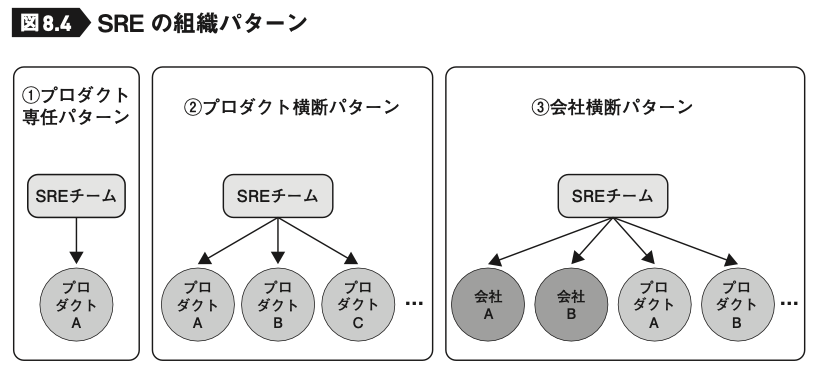
It is explained in the book.Three organizational patternsandThree SRE implementation modelsThis is based on my own experiences.
Three organizational patterns
- Product-focused pattern: The SRE team is dedicated to a single product.
- Cross-product patterns: SRE team is responsible for multiple products
- Company-wide patterns: The SRE team is responsible for multiple companies and products.
Three SRE implementation models
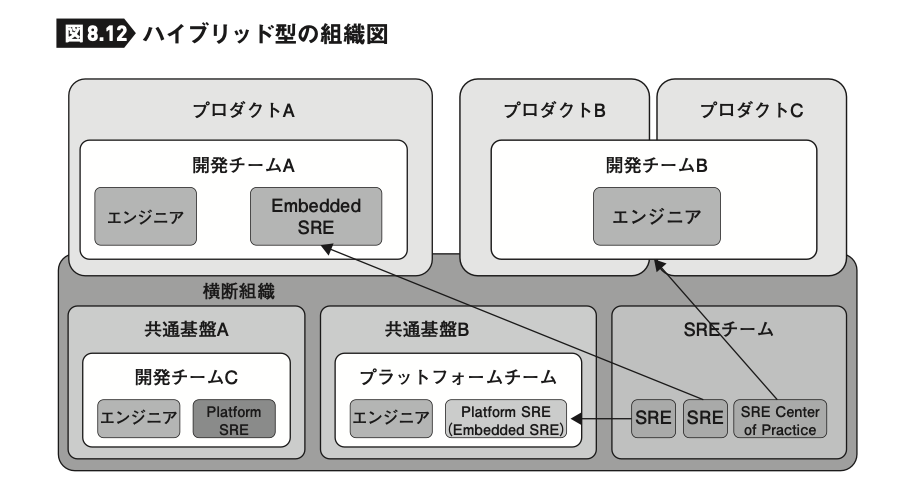
- Embedded typeA model in which a specialized role within the organization (in this case, a site reliability engineer) directly participates in and works together with other teams.
- Product SRE and EFFECTION SRE
- centralizedA model in which SRE teams and functions are centrally managed within the organization, and reliability is improved with a unified perspective and approach.
- SRE Center of Practice and Platform SRE
- Hybrid typeA model that combines the characteristics of both embedded and centralized systems.
For details on the three organizational patterns and three SRE implementation models, I highly recommend purchasing the book. Furthermore, I hope the book will help readers select the SRE implementation model and pattern best suited to their organization's challenges and needs.SRE implementation pattern selection treeWe have also made it publicly available, so we hope you will find it useful.8.5.3 Summary of SRE Implementation Models and Pattern Selection MethodsAs mentioned in the previous section, organizational design doesn't always work out exactly as written, so in those cases, don't be afraid to change.Customize implementation models and patterns to suit your organization.Please also consider doing that.A dedicated SRE is not always necessary.Please don't forget that either.
Things I couldn't write
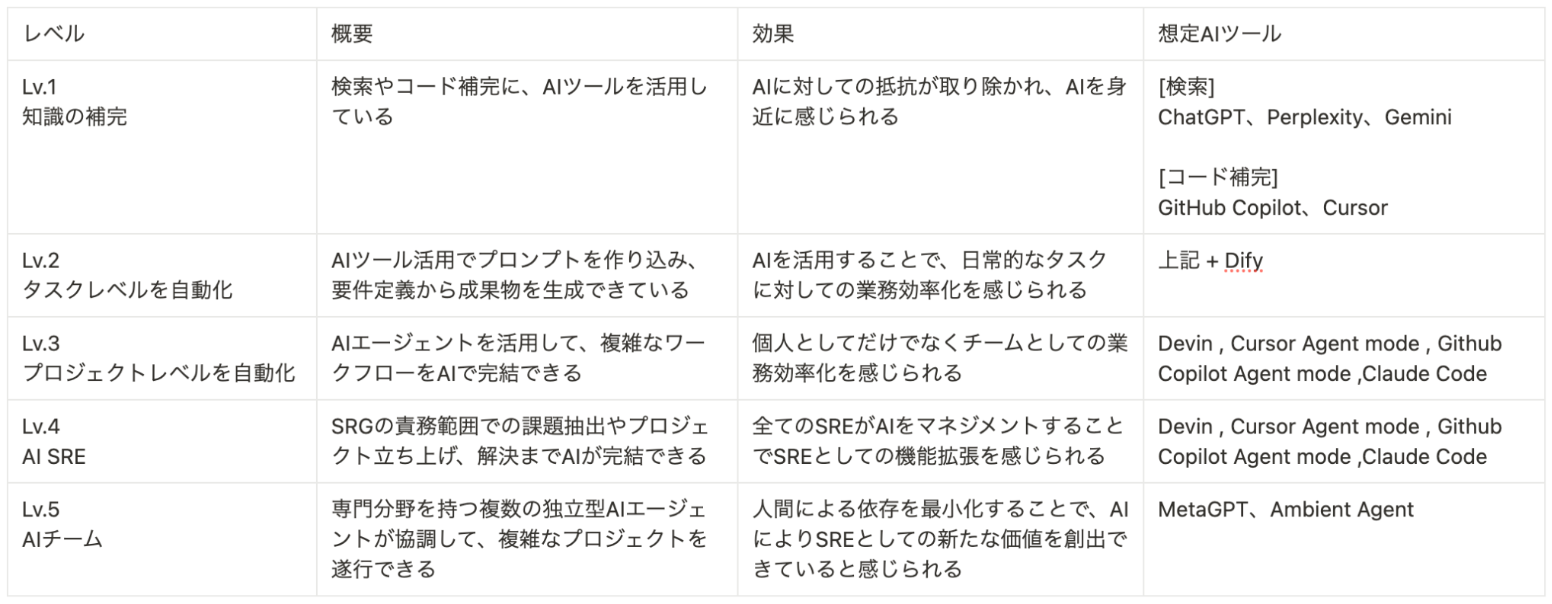
Due to the writing deadline, I'd like to share some things that I couldn't include in this book. AI technology is evolving at a speed that exceeds many people's expectations. Just as organizational structure is crucial for promoting the practice of SRE, it is also very important for promoting the use of AI. Although I couldn't write about it in this book, some people may be interested in how SRE organizations will change in the age of AI. In fact, SRG is also promoting the use of AI, and the use of AI technology is expanding broadly, not only in the SRE domain but also in areas such as enhancing output and management. Furthermore, SRG provides support for AI utilization not only in infrastructure and SRE domains but also for businesses and services.
Beyond simply utilizing and supporting AI, SRG aims to establish AI SREs and AI SRE teams, with the goal of having a fully functional AI SRE team by the end of 2026. To achieve this, one of the centralized implementation patterns isSRE Center of PracticeI believe this will become extremely important.
In conclusion
Lately, I've been hearing a lot about whether SREs will still be necessary in the age of AI. I think this is because the quality of generated AI has improved due to advancements in AI technology, but personally, I believe there will still be a need for SREs. However, I think the scope of responsibilities, approaches, and areas of focus for cross-functional SREs may change depending on the size of the organization. I'd like to talk about this in more detail another time. If you're interested, please invite me to a drink or an event.
Once again, I hope that this Advent Calendar will help many people learn about the initiatives our group is undertaking. I'm personally looking forward to it as well.
If you are interested in SRG, please contact us here.