[KubeCon Day 4] Participation Report
Suzuki from the Service Reliability Group (SRG) of the Media Management Division@sZma5a)is.
#SRGThe Service Reliability Group primarily provides cross-functional support for the infrastructure of our media services, focusing on improving existing services, launching new ones, and contributing to open-source software.
This article is a report on our participation in KubeCon, introducing the keynote and session content from Day 4.
Introduction
KubeCon + CloudNativeCon North America has finally reached its final day, Day 4.
On this final day, numerous important announcements shaping the future of cloud-native technologies and concrete sessions addressing real-world challenges were held.
This article summarizes the Day 4 keynotes and reports on sessions that I personally found particularly interesting.
Keynote
The final day's keynote address covered a variety of topics, reflecting on the conference so far and offering a glimpse into the future of cloud-native technologies.
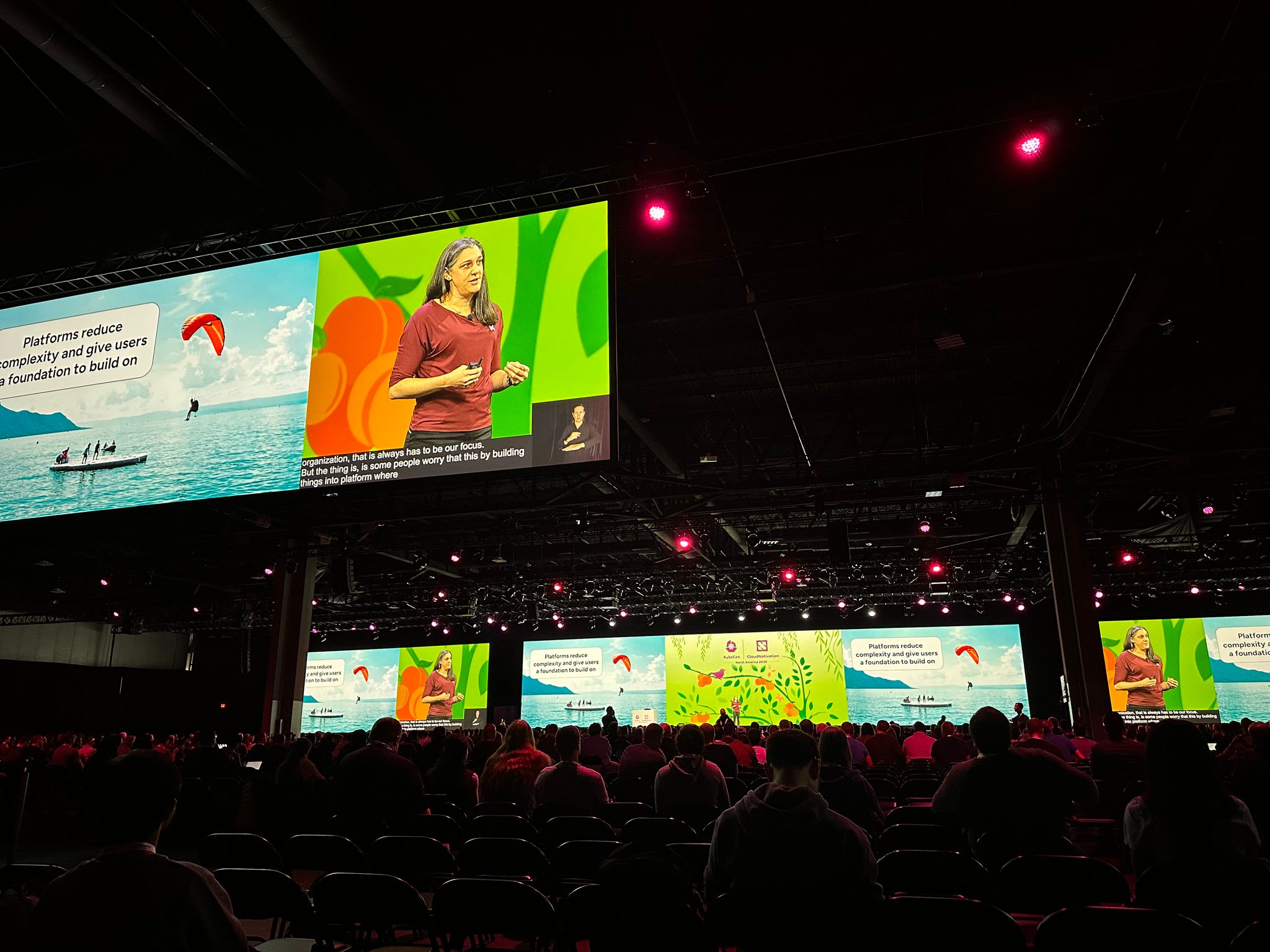
The evolution of platform engineering and the mitigation of complexity
The presentation discussed the challenges and success factors of platform engineering, noting that while template distribution is convenient, it can easily lead to a distribution of operational burden.
It emphasized that three principles are crucial for a successful platform: "self-service via APIs," "continuous adaptation to the business," and "treating it as a managed service." It stressed that companies should leverage market services while identifying and building their own unique value proposition.
Kubernetes, the foundation of the AI era
Next, several companies presented case studies on the relationship between Kubernetes and AI.
They discussed how important Kubernetes is as a high-performance, secure, and open foundation for building large-scale AI platforms.
In particular, specific technical demonstrations were shown, such as AI inference in multi-cluster environments and GPU resource optimization, illustrating how open-source technology and the contributions of the CNCF community support rapid AI development for companies.
Standardization of Kubernetes networking
The networking session highlighted the evolution of Kubernetes' networking capabilities to support new workloads such as AI and HPC (High-Performance Computing).
Of particular note was DRA (Dynamic Resource Allocation).
This is a new API for allocating specialized hardware resources, such as GPUs and high-performance NICs, to Pods in a more flexible and standardized way.
This is expected to unify resource management mechanisms that were previously implemented independently, enabling centralized management.
The last decade of cloud-native technology and what lies ahead.
Experts from Akamai and Microsoft discussed the past decade of cloud-native development and its future prospects.
They reported on the healthy growth of over 70 CNCF projects, particularly accelerating efforts in the areas of AI and security.
Amazon's presentation specifically explained how they utilize machine learning for service capacity planning and risk assessment during large-scale events like Black Friday.
They highlighted the importance of cross-service team collaboration and stress testing based on dynamic predictions in handling traffic surges that simple auto-scaling cannot cope with.
Introduction to particularly interesting sessions
I've picked out three sessions that I found particularly interesting from among the ones I attended, and I'd like to share them with you.
In-Place Pod Resize in Kubernetes: Dynamic Resource Management Without Restarts
resizePolicySecuring Data Applications at Pinterest With Finer Grained Access Control on Kubernetes
valanceTurbocharging Argo CD: Replacing Redis With Dragonfly for Better Performance and Lower Bills
An engineer from Acuity, who also maintains Argo CD, presented a case study on replacing Redis, which was used as a cache, with "Dragonfly" to improve Argo CD's performance and cost.
Argo CD uses Redis as a cache to improve UI response speed, but a high-availability (HA) configuration requires many Pods and containers, resulting in high resource consumption.
By replacing it with Dragonfly, a new in-memory cache compatible with Redis, they reported being able to reduce the number of Pods by approximately 30% and the number of containers by approximately 40%.
In one customer case, memory usage dramatically decreased from 9% to 3%, leading to cost savings.
Dragonfly is already GA (General Availability), and the presenter emphasized that it is "production ready and being used in production environments."
Since we also use Argo CD in many of our services, this case study provided extremely useful information that we can immediately apply.
summary
My four-day participation in KubeCon was an excellent opportunity to absorb new technology trends.
In particular, I realized that themes such as platform engineering, AI infrastructure, and the security and cost optimization that support them will serve as important guidelines for future technology selection and system design.
Furthermore, the enthusiasm shared in each session and the interaction with engineers from around the world significantly boosted my motivation for technology.
I intend to leverage the knowledge and perspectives gained here to identify challenges facing our company's services and develop new solutions.
SRG is looking for new team members.
If you are interested, please contact us here.