
What is Cloud SQL Enterprise Plus?
This is Onikai (@fat47) from the Service Reliability Group (SRG) of the Technology Division.
#SRGThe Service Reliability Group primarily provides comprehensive support for the infrastructure surrounding our media services, focusing on improving existing services, launching new ones, and contributing to open-source software (OSS).
This article explains the new features added to CloudSQL Enterprise Plus, as announced by Google Cloud Platform.
What is CloudSQL Enterprise Plus?Additional features in Enterprise PlusImproved availabilityImproved performanceImproved maintenanceImproved data protection featuresEnterprise Plus pricingSupplementary information on data cachingHow to get started with CloudSQL Enterprise PlusIn conclusion
What is CloudSQL Enterprise Plus?
This is the Cloud SQL edition that was released as generally available (GA) in July 2023.
The existing Cloud SQL will become "CloudSQL Enterprise".
CloudSQL Enterprise Plus, an enhanced version of the standard CloudSQL with additional features, has been announced.
The supported databases are MySQL 8.0 and PostgreSQL 14 and 15.
This article will focus specifically on MySQL.
Additional features in Enterprise Plus
Improved availability
99.99% SLA
Incidentally, the old CloudSQL had a 99.95% success rate.
Improved performance
Write latency is up to twice as fast.
Read throughput improved by up to 3 times.
You can optionally use a new feature called data caching.
A fixed-capacity SSD, depending on the machine type, will be provided and can be used as an extended buffer pool area.
When data caching is enabled,
- Read: Reads in the following order: main memory → data cache → instance storage.
- Write: Simultaneously commit to instance storage and write to the data cache.
This is the action that will occur.
Improved maintenance
During planned maintenance, rolling updates are performed in the background to minimize downtime to less than 10 seconds.
The old Cloud SQL took less than 60 seconds.
Improved data protection features
Log retention period for PITR extended to a maximum of 35 days.
*MySQL support is not yet implemented but is planned.
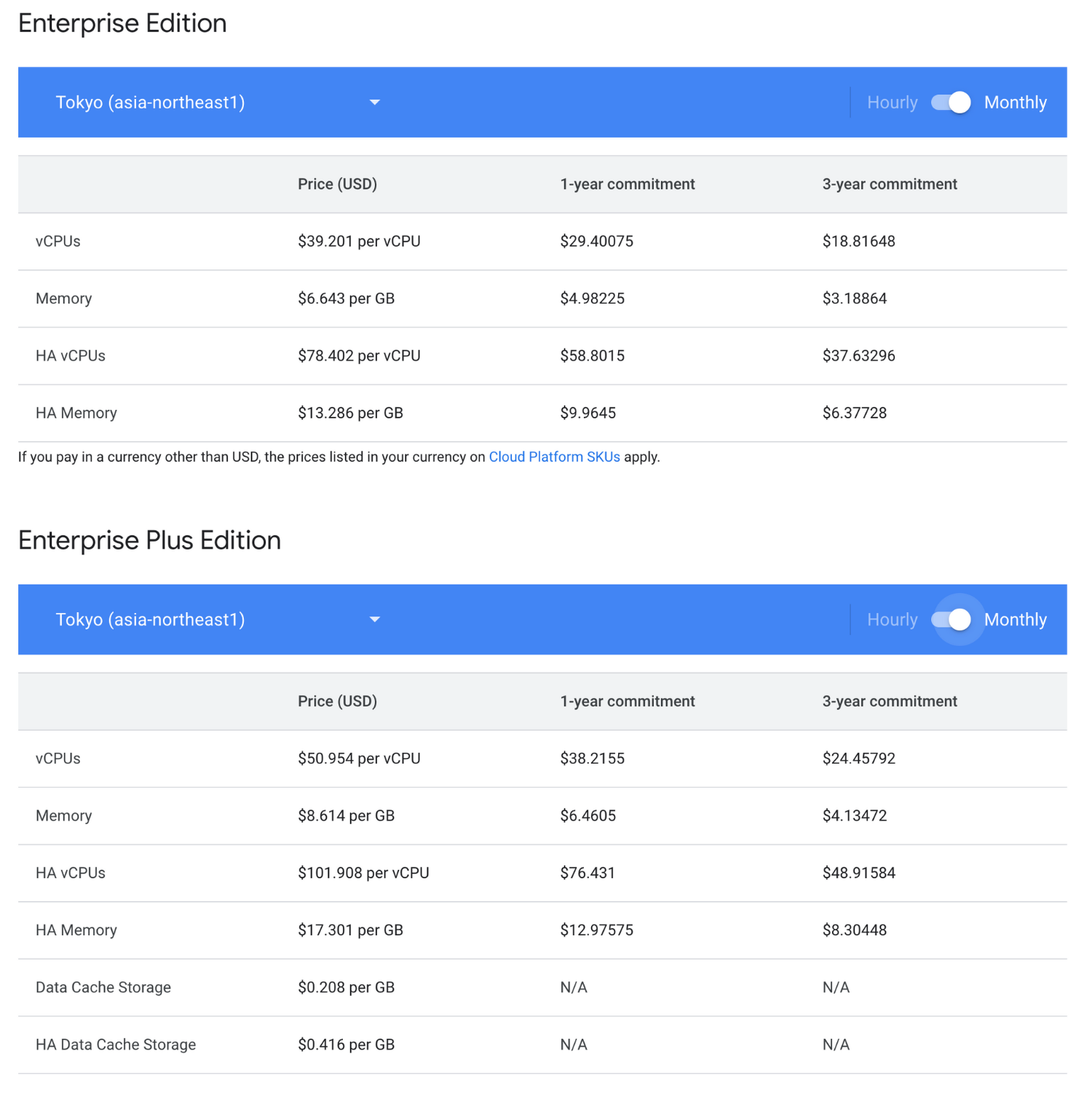
Enterprise Plus pricing
It's roughly a 30% increase compared to the old Cloud SQL.
For details, please check the Pricing section at the URL below.
Supplementary information on data caching
One perfect use case is when the dataset is so large that it cannot fit into a normal buffer pool.
Furthermore, significant performance improvements are expected if the target instance has 16 or more vCPUs.
When the data cache is full, data with low access will be removed.
The data cache will not be lost even if the instance is restarted by the user or the system.
However, if the primary instance shuts down due to a failover operation or other reasons, the data cache will be erased, which may result in a decrease in performance until the data is re-cached.
The data cache does not store redo logs or binary logs.
How to get started with CloudSQL Enterprise Plus
Simply select "Plus" when creating your Cloud SQL database.
There is currently no feature to migrate existing Cloud SQL to Plus.
For migration from the existing environment:Database Migration ServiceYou will need to use methods such as [mention specific methods here] to migrate the data.
I'm looking forward to the future implementation of a feature that will allow for in-place migration.
In conclusion
I believe that the added features in CloudSQL Enterprise Plus have made managed databases even more convenient to use.
Personally, I really liked the improved performance and the reduced downtime due to improved maintenance.
While this will result in a slight increase in costs, I believe that the improved performance may allow us to offset these costs by reducing the instance size or the number of instances used.
This update makes me feel optimistic about future developments, so I'm looking forward to what's to come.
SRG is looking for new team members.
If you are interested, please contact us here.
SRG runs a podcast where we chat about the latest hot IT technologies and books. We hope you'll enjoy listening to it while you work.